
It's raining in Lappeenranta right now, so it's a good time to look at the importance of rain in coffee growing!
Water is an important element in all growth, but especially in coffee.
Coffee needs the right amount of water at the right time of year so that the delicate blossoms develop into ripe and delicious coffee berries, the coffee seeds inside of which contain the most flavors possible, which can then be cooked through skillful roasting so that the aromatic drink called coffee can be extracted from the properly ground coffee!
Coffee needs a surprisingly large amount of water to grow, about 2.5 meters per year. The amount of rainfall is measured as the amount of water that falls on one square meter per year – in coffee's favorite countries, the height of the annual water column varies between 2-3 meters, while in a much drier environment, such as Finland, the average rainfall is about 70 centimeters per year.
As a side note, coffee bushes are not watered, but rather are hydrated by nature's own irrigation system. That's why the extreme weather events brought about by climate change are not something any coffee drinker would wish for.
What happens if there is too little or too much rain?
When it comes to coffee, water needs to fall sufficiently, at appropriate intervals and with the appropriate intensity.
If there is too little rain, the coffee berries will remain stunted and the delicate coffee bush itself may not survive.
If there is too much rain, the effect is not as direct, but several factors become a problem: flooded embankments can carry away valuable substances from the soil, moisture can cause mold and facilitate the spread of plant diseases. If it rains heavily during the harvest phase, the berries can become waterlogged and swell too much, and if there is hail during the flowering phase, the entire harvest season can be ruined.
But that's about it, let's focus on the happy things. In an optimal life, which we live on average, rain falls on the soil managed by coffee bushes in early spring before the bushes bloom. There should be little water during the flowering stage itself, as is often the case in late spring.
During the growing season, when the berries have formed and are in a growth spurt (approximately 2-5 months after flowering), it would be a good idea to water the berries in a normal amount so that they grow and gain the necessary strength.
Then, about nine months after flowering, it is time to harvest. It would be good if the rainy season had ended as it usually does and we could only pick perfectly red or yellow coffee berries (the color depends on the variety) in reasonably dry weather. If it rains a lot at this time, there is a risk that the roots will absorb a lot of water and the coffee berries will swell. Another potential problem is picking wet berries, which makes the picked berries more susceptible to spoilage.
After the harvest season, we hope for more rain so that the next cycle can start and the coffee bushes can enter the flowering phase again!
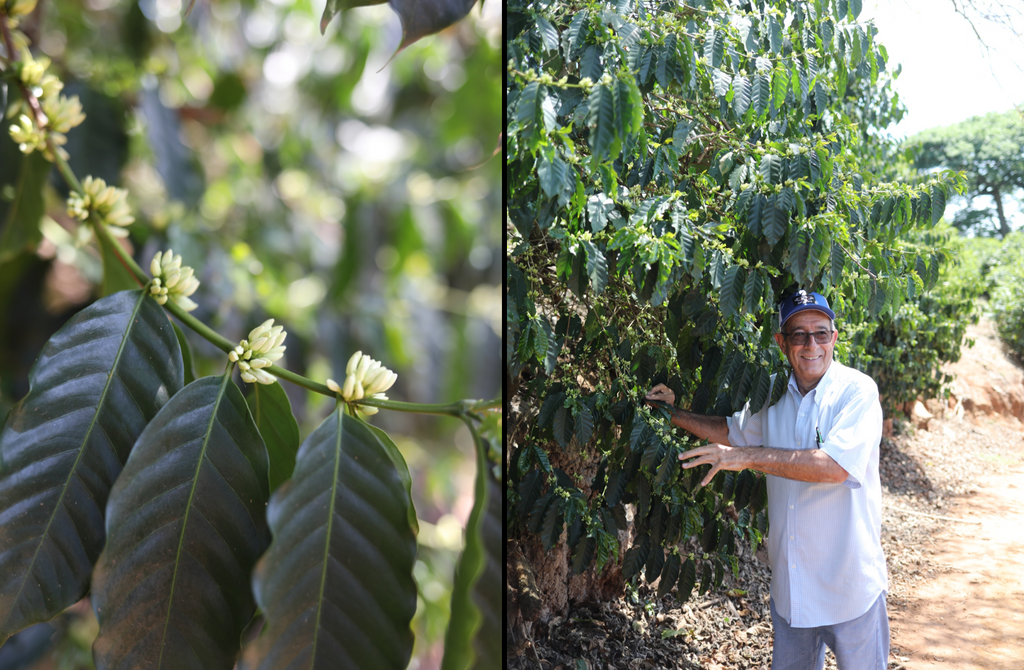
(In the main image of the article, Fazenda IP farm owner Luiz Paulo Pereira shows coffee bushes in the flowering stage. Photo: Arttu Muukkonen)