
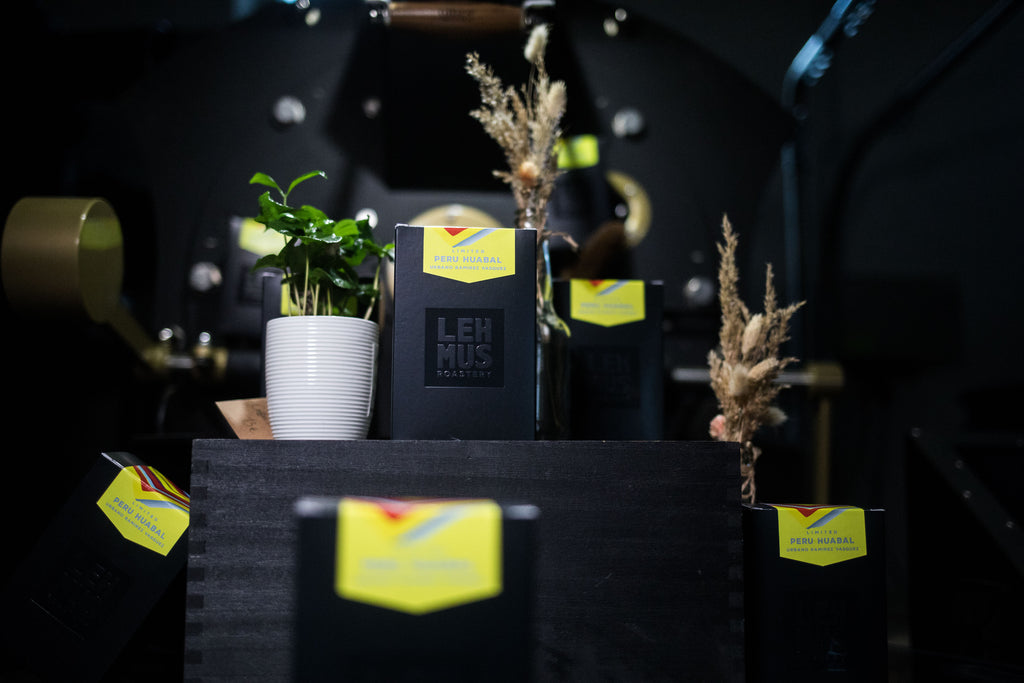
Lehmus Roastery is launching a new coffee today, as the Limited edition coffee Peru Huabal, packaged in a black box, sees the light of day.
This sweet, fruity and smooth coffee comes from Urbano Ramirez Vasquez's three-hectare farm in San Antonio, Huabal region in northern Peru, near the Ecuadorian border.
The coffee is grown at a very high altitude, at 1700 meters, and it gets its special taste not only from the soil and the prevailing climate, but also from the processing. The coffee is natural, or sun-dried, but the drying is preceded by washing the coffee, overnight fermentation and drying takes 30 days. This is an exceptionally long time, as coffee is usually dried in about two weeks.
Slow drying allows the sugars in the coffee berry to impart their own flavor to the coffee bean, and the result is a very delicious coffee!
But Peru, its history as a coffee country is interesting: the story involves guano fertilizer, British land control, and whatnot.
Peru is an emerging specialty coffee country – blame the British!

This is Lehmus Roastery's first Limited Series coffee from Peru. For the Limited Series, we source interesting small batches from around the coffee-producing world. This time we got a real small batch, as there are only a little over 50 kilos of coffee available.
Why haven't we had a Peruvian specialty before, you ask? The answer is that Peru is an emerging country in specialty coffee, so the development is just beginning, and now we get to jump on it.
Everything can ultimately be blamed on the conquerors, in this case Spain and Great Britain.
Coffee has been cultivated in Peru since the 18th century, but commercial coffee cultivation did not begin until the 19th century. The British dominated Peruvian coffee cultivation throughout the late 19th and early 20th centuries, which may sound strange, but there is a logical explanation.
Peru was once conquered by the Spanish, and in the 19th century, Peru freed itself from the yoke of the conquerors in 1821, but decades of disputes with neighboring countries meant that the country was constantly in need of money. This was obtained, among other things, from Great Britain.
Great Britain was a world power at that time, sourcing coffee from various parts of the subtropical coffee-producing zone around the world and selling it in Europe.
Great Britain also lent money, and due to debts and basic trade relations, Peru supplied Great Britain with chicken droppings and eventually also gave land.
Let's start with guano, a local bird droppings rich in phosphorus and nitrogen. In the best years, up to 300 tons of it were shipped from Peru to the UK as fertilizer, mainly for growing turnips.
In the 19th century, there were also several showdowns in South America over guano, but we won't go any further than that in this fertilizer issue.
All the same. Peru was at enmity with its neighbors (or vice versa), and the state was impoverished by constant warfare. So, as compensation for some outstanding debts, Peru was forced to give up two million hectares of its land to Great Britain.
It's good to do something productive with land holdings, so the majority of these hectares were taken over as coffee plantations.
Well, the world wars came and Britain started to need cash, so Peru eventually bought the land back. Coffee plantation operations ceased and the land was divided among thousands of small farmers. At the same time, direct markets to Europe also disappeared, and Peru had to start coffee production all over again without a major local player.
And we are now following this development in its final stages: in recent decades, many organizations have been operating in Peru, and Peru is currently one of the largest coffee countries producing organic and Fair Trade certified coffee, although the quality has still been fairly poor.
In recent years, coffee brokers specializing in specialty coffee have begun to develop collaborations with local farmers, and as a result of this work, we can now enjoy Limited Peru Huabal. Let's go a little deeper after the pictures.

Why is development only happening now?

Peru is a large country with long distances. In addition, the country lacks a kind of union that would provide resources for developing cultivation, as in more developed coffee producing countries such as Brazil and Colombia. Although the coffee itself is already good, the long distances and lack of cooperation and education do not really help farmers recognize the potential of their coffee.
As with all production, a product can be really good, but if there are no known buyers for it, there is no way to get the product to people's attention.
Peru has also traditionally grown Catimore varieties, encouraged by both the state and large multinational buyers. At some altitudes, this variety has produced good yields and reasonable quality, but especially at high altitudes, the varieties do not fare well: yields are poor and quality is not great.
Today, many farmers, like Urbano Ramirez, who produced this coffee, have been able to use the premiums received from specialty coffees, or quality compensation, to plant new varieties, such as Catuai, Caturra and Bourbon, which, when well cared for, produce good yields and excellent taste.
Lehmus Roastery's Limited Huabal is indeed Catuai Arabica, a new wave variety. The coffee is grown at an altitude of 1,700 meters, and altitude also affects the sweetness of the coffee: the higher the coffee grows, the greater the temperature fluctuations between night and day, and the more the coffee produces carbohydrates to protect itself from the cold.
The Huabal region spreads over a mountainous and partly inaccessible area. Some valleys have very humid and reddish clay soil, which is normally typical of African coffees, while others have a distinctly hotter and drier climate.
So there are really interesting and special flavor profiles to be found in the region.
We predict that Peru's story in the specialty coffee world is just beginning.

 The package label shows references to the coloring of Mount Vinicunca.
Limited Peru Huabal
Sensable in the taste:
Blueberry, sugariness, dates, liqueur-like sweetness, soft acidity.
Country: Peru
Origin San Antonio, Huabal , Cajamarca
Grower: Urbano Ramirez Vasquez
Bean: Catuai Arabica
Processing: Natural, fermented overnight
Growth altitude: 1700 m
Special: The coffee is dried slowly, for as long as 30 days.
Cupping score: 87.5p
Buy from our online store now! (Editor's note: product sold out and link removed!) Check out our current Top Shelf selection here!