
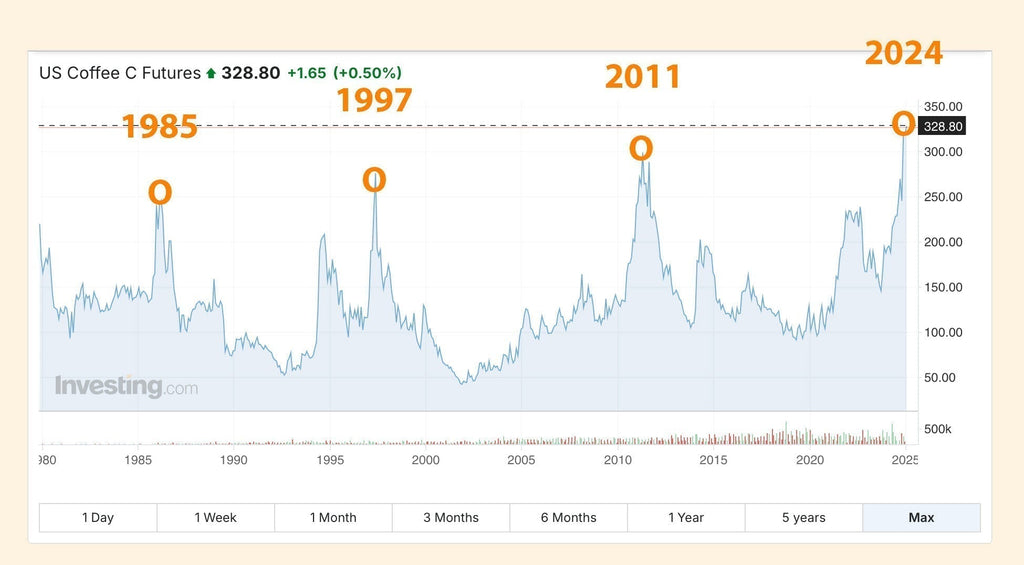
The most popular coffee variety, Arabica, is traded in futures on international exchanges, and this price is followed by all coffee industry players, from farmers to traders and roasters to consumers.
Currently , in January 2025, the world market price is about $3.30 per pound, or about €7.06/kg. Just a year ago, the same price would be around 1.75, meaning that basic bulk coffee was almost half the price.

What else makes up the price of coffee?
In addition to the base price alone, freight costs are currently high due to unstable political situations in various maritime areas, meaning coffee and other raw materials move slowly and uncertainly.
In addition to the cargo, approximately 15% of the raw weight of the coffee evaporates into the air during the roasting process, when coffee When roasted, water evaporates from it.
In addition, roasters that roast specialty coffees, mainly small roasters, pay a premium, or additional price, for the coffee, called quality compensation. The higher the quality of the coffee, the more is paid for quality.
In addition, brokers want their own margin so they can purchase, store and distribute coffee, and of course roasters have their own costs. The dollar-euro ratio also plays a role. When coffee is sold in dollars and bought in the currently weak euro, the price rises. price for roasters in eurozone countries even more.
Why does the price of coffee spike at regular intervals?
First spike: drought in Brazil

When supply decreases, the prices of things tend to rise, unless demand decreases. Coffee is always drunk, so to speak, so prices rose.
From a farmer's perspective coffee A rise in the stock market price is in principle a good thing IF the production difficulties are not related to his plantations and do not continue for a long time. If he previously received, say, one euro per kilo for the same coffee without special processing, he suddenly receives three euros per kilo for the same coffee. If, on the other hand, frost or drought hits his plantation and destroys, say, 20 percent of the coffee bushes, it will take several years to even get production back to the same level.
Coffee is a very sensitive plant and practically cannot withstand frost at all. The plant may not be completely destroyed in a couple of nights, but the crop in question will be practically gone. Coffee also needs a lot of water and it only grows in the subtropical zone, where it rains an average of 2.5 meters per year. For example, in Finland, it rains an average of 70 centimeters of water.
Second spike: drought in Brazil

Coffee is usually sold by harvest season, meaning that the fresh harvest season is sold by the time the new harvest season is completed. Fresh coffee tastes better than over-year-old coffee, although coffee can theoretically be roasted no matter how old it is, the taste is not necessarily that different. Since stocks are always only for one harvest season, a production volume that deviates from the forecast affects the price – again upwards.
Coffee-producing countries had a common a price and production system that kept prices and production volumes relatively stable. This organization and the contractual system it created were dismantled in 1989 and after coffee price has been prone to fluctuating sharply when the price is allowed to float. In other words, in the 1990s, coffee also began to be seen as an investment, with coffee futures seen as a medium of exchange similar to oil and other commodities in the commodity markets.
So coffee Investors often benefit from a high stock market price, not coffee farmers, roasters or coffee consumers. When coffee price rises, demand also begins to wane in lower-income countries. When coffee is expensive enough, consumption may shift to other refreshing drinks, which in the long run coffee popularity is decreasing. That's not really in the farmer's interest. And certainly not in the coffee roasters' interest either.
Third spike: drought and rain in Brazil and Colombia 
In 2011 coffee price became more expensive than ever before. Colombia experienced torrential rains and many plantations suffered from mold on the bushes. Brazil also experienced drought and coffee production was significantly lower than usual.
In the 2010s coffee New consumer groups have also raised prices. Traditionally, tea has been drunk in Asia, but the middle class in China, India and Indonesia has started drinking coffee and demand has grown in these populous countries. The same trend continues coffee at the cost of.
Fourth spike: frost and drought in Brazil and Vietnam

The 2023 harvest was weaker than usual in Brazil due to natural variability, so the 2024 harvest should have been a good success.
The 2024 harvest was hit by frost again. Now, in January 2025, Brazil is suffering from drought again: last week, only 31% of the normal rainfall was recorded in Minas Gerais, and the same trend has continued for some time.
Prices are also being driven up by movements in the commodity markets by investors and speculators. There is greater interest in coffee than ever before, and demand, of course, always drives up prices. (in the same way that so-called meme stocks saw strong growth during the corona period).
When will the price of coffee go down?
In theory, coffee can be purchased in futures contracts up to two years in advance. Futures are like a price ceiling that commits the buyer to buy coffee at a given time. Futures also predict coffee price at least in some time frame. At the moment coffee Prices will remain very high, at over $3 per pound, at least until the end of 2025.
On the other hand, even after previous peak years, farmers have increased their production and there has been an oversupply in the coffee market, which has decreased. coffee world market prices.
On a more concrete level, you can think of it this way: right now, brokers have bought and are buying coffee at a high price. Before next year's harvest, it doesn't make sense for brokers to sell coffee at a loss. So there simply isn't any cheaper green coffee available, at least not if you want quality coffee.
In principle, you could buy cheaper coffee, but then we are not talking about high-quality coffee, but about various types of residual and low-quality coffee. Of course, everyone knows what kind of end product you can expect if the raw materials are bad in every way.
Is this time different?
"This time it's different" is a sarcastic comment when predicting the impact of various things, such as the finality or impact of stock market crashes in the financial world.
It must be said out loud that climate change is already affecting coffee farming, so it may be that this time it is different. Coffee is a sensitive plant, and unexpected weather extremes have increased significantly. It is not just warming that affects coffee, but also unexpected frosts, rains and droughts. These phenomena are predicted to increase even more, so coffee price may vary even more in the future, and there may not be a return to truly affordable coffee.
More weather-resistant coffee varieties are constantly being developed, and we are seeing some improvement in the previously overlooked Robusta variety and its quality. However, this does not eliminate the root cause.

How much does the price of green coffee affect the price of a small roaster package?
Many roasters have either annual or other long-term contracts, so some may still have reasonably priced coffee in stock. At some point, they will run out of stock, and in order to continue operating profitably, they may have to raise prices or cut costs. On the other hand, the industry has been going through tough times for a long time, so efficiency improvements have probably already been made.
In small roasteries, the proportion of raw materials in the price is relatively slightly lower than in large industrial operators using automatic equipment, which in turn have a significantly lower proportion of personnel than artisan roasteries. Raw materials are more valuable in small roasteries than in industrial operators, but their price It won't double, although it's already come close.
Some roasters may switch to roasting cheaper coffees, but as mentioned, specialty coffees have several quality criteria, and skimping on them doesn't fit the philosophy of many quality roasters. The difference is also noticeable in the taste, because coffee is a simple thing, after all!
Many roasters, including Lehmus Roastery, also agree on prices without the influence of the stock exchange price. We agree that we will pay the partner farmer a certain flat amount of euros per kilo for a certain quality of coffee, which exceeds the usual market-based pricing. This way, the farmer knows that he is receiving proper compensation for the particularly high-quality coffee, and the flatness helps all parties to plan their lives forward.
Can I buy coffee futures?
If you want to invest in the coffee market, you can buy coffee futures on different exchanges through different brokers. We have no intention of going into futures trading, because it is comparable to betting, at least at the level of expertise of a small roaster, so we focus on roasting high-quality coffee and serving it in our own café day after day.
Here's a little older an article that reviews coffee futures trading. If anyone is buying futures, please let us know by replying to this message, we would love to hear more!