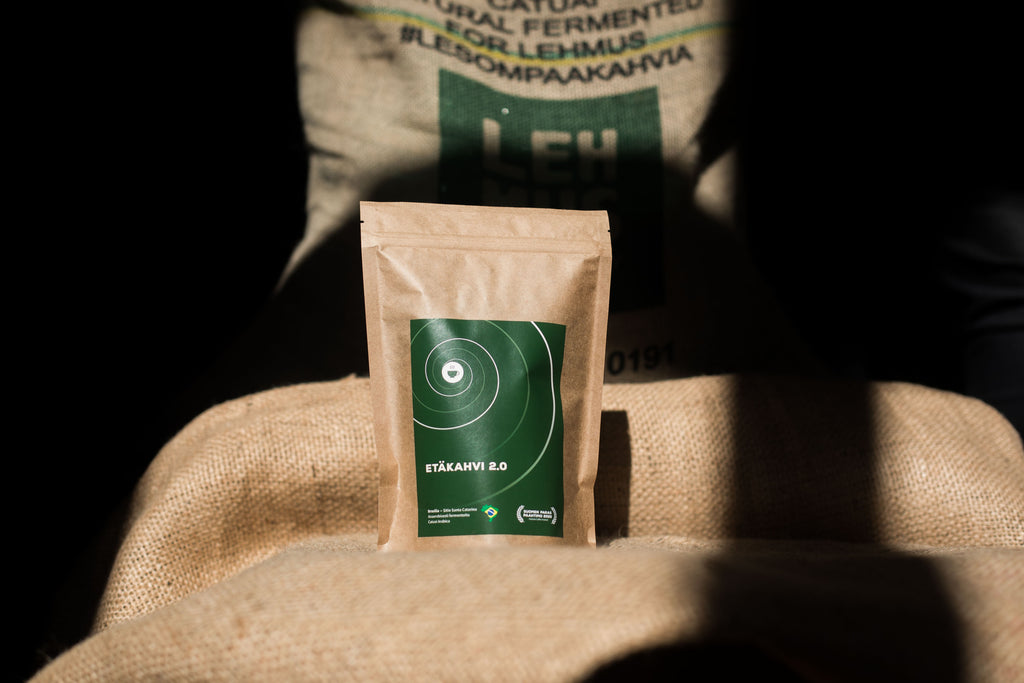
In March 2021, a pallet of coffee arrived at the roastery, including a few bags of coffee decorated with our logo and texts.
It's somehow both a smile and a moving thing to see these things printed on a jute bag, because besides being funny, this tells of a long development process for the entire roastery. The development work is still ongoing, but this is a kind of milestone and a stopover for us, which we'd love to tell you more about.
Small roasteries usually buy coffee through intermediaries, and although you can theoretically buy coffee directly from the farmer, in practice there is always someone involved who still delivers the coffee and handles various tasks related to logistics and other things, at the very least.
Of course, we are interested in being the first to get our hands on various top coffees, and the route to them is usually through relationships. Either by getting to know the farmers yourself (which requires traveling and attending international events) or by establishing such good relationships with intermediaries that coffee batches start to be available in advance before the coffees even appear on general sales lists.
 On a visit to the Sitio Santa Catarina farm in autumn 2019. Photo: Arttu Muukkonen
All of this takes time. You have to make purchases consistently year after year, that is, in this way you demonstrate your reliability to the coffee broker. You have to be in contact with different parties so that they also learn what, for example, our roastery wants, what kind of coffees we are interested in. And of course we have to get to know the people who buy coffee from us: do they want really berry and fruity coffees, for example, or what style interests them. Or what do we decide to offer?
Experience and immersion produce results
Lehmus Roastery has only been around – or already, depending on your perspective – since 2016. Coffee harvests come once a year. So we’ve only been around for about five harvest seasons, and it’s only been a couple of years since we’ve had enough volume to really delve into different routes and ways to develop our small-batch operations.
Of course, we have been aware of different ways to source coffee and thereby support the farmer and thereby achieve development, but in business, volumes also matter: of course, the farmer and broker are happy with every bag of coffee sold, but understandably, if we can buy the entire harvest (for example, 100 bags) from a farm, the operation is then more sustainable.
The journey of the sacks shown in the pictures and a few others began in the fall of 2019, when we were able to visit Brazil in connection with the Carmo Best Cup competition, and got to know the farmers of the Sitio Santa Catarina farm, To Alexandre Silva and Rodrigo Silva Pimenta and their families.
We bought a batch of their anaerobically fermented coffee, which was a top 15 coffee in the Best Cup competition. If anyone still remembers Remote Coffee, it was that noble drink. Santa Catarina has been involved in the development program of our partner Cafe Imports' local partner, Carmo Coffees, for a few years.
The farm is small, only five hectares, but Alexandre and Rodrigo have been interested in developing their cultivation and processing methods. About four years ago, the leaders of the Carmo Coffees development program asked if they would like to join in and do even more work for coffee, and here we are.
Last summer and fall, we communicated extensively with Rodrigo, and were able to influence the types of treatments they applied to the fresh harvest. We were also committed to purchasing the results of the development work, so we were able to guarantee our support for them, so they could experiment without fear that the coffees would not sell.
Rodrigo and Alexandre on their farm's drying patio in autumn 2019. Photo: Arttu Muukkonen
So in late autumn we got to taste a 72-hour fermented batch of Catuai Arabica grown at a certain point on the farm, and now that coffee has arrived at our roastery - along with another interesting new feature, more on that later.
Again, our idea was to make coffee for the spring Helsinki Coffee Festival, but since the event was moved to next spring, there is something to do for this batch of coffee too, and now we have created Remote Coffee 2.0 (Product sold out, so link removed) !
We were also asked if we wanted a print on the jute bag. We said yes. After the print job, Cafe Imports was asked what
#lesompaakahvia actually meant, since Google Translate didn't recognize it. It took a while to get the answer!
What about the future?
Our goal is to be able to source larger quantities of coffee from individual farms regardless of the harvest season. The flavors of the coffees may vary slightly from year to year, but continued collaboration gives both the farmer and the roaster better support to implement the values that both parties, including their intermediaries, want to implement: to grow, sell and roast responsibly produced specialty coffee.