
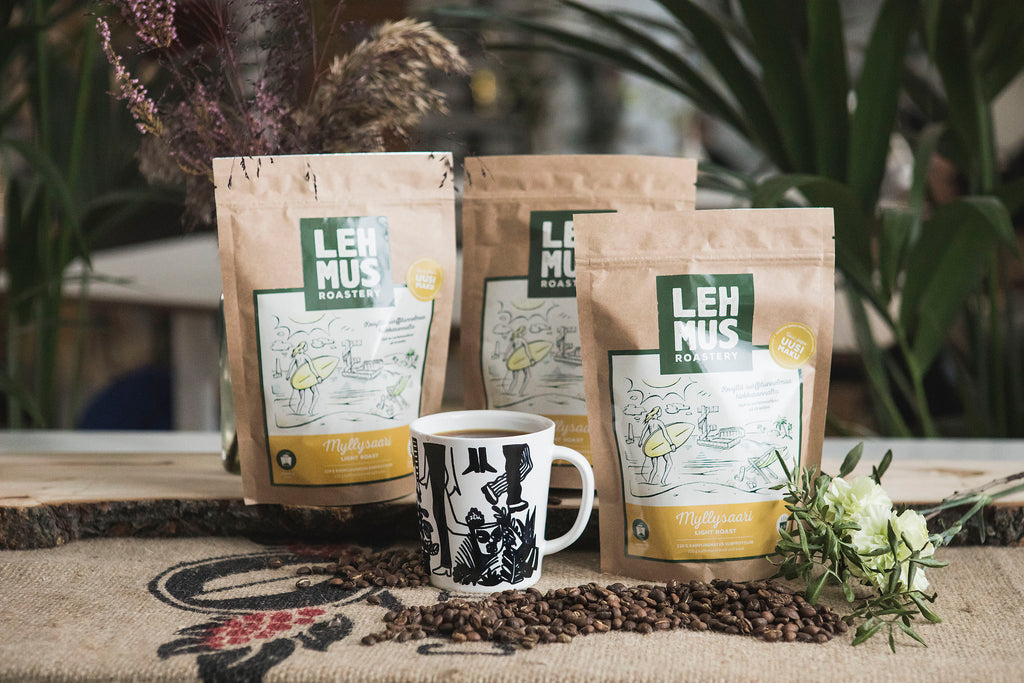
The lightest representative of Lehmus Roastery's popular neighborhood coffees is Myllysaari .
Light roast coffee is a fresh and sweet coffee, with a refreshing acidity and a fruity taste that pampers the taste buds. The coffee is roasted from Ethiopian Heirloom Arabica coffee beans, which grow in the Kochere Yirgacheffe region in the Ethiopian mountains. The coffee is originally from Ethiopia, so Myllysaari coffee comes from there, from the birthplace of the coffee plant!
The coffee is grown by small farmers in the area. It is therefore a so-called single origin coffee.

The coffee growing environment in the Kochere area. Photo: Cafe Imports
Myllysaari beans, like all Lehmus Roastery coffees, belong to the specialty coffee quality category. The coffee is particularly tasty, the berries are picked ripe and by hand. The production is ethical and responsible, and the farmer receives good compensation for this valuable product.
 Heirloom Arabica in raw and roasted form.
The coffee beans are grown at an altitude of 1795-1900 meters. The beans are processed using the washed method, meaning the skin and pulp of the coffee berries are separated from the beans by washing them in water. The washed processing gives the coffee a bright taste, in which the bean's own aromas stand out perfectly.
The predominant soil type in the area is reddish-brown clay, which, together with weather, heat, growing altitude and other factors, gives the coffee a berry-like, acidic flavour reminiscent of stone fruits such as apricot.
Berry, fruity and floral aromas are typical of coffee beans grown at high altitudes in Ethiopia, as the berries grown at high altitudes accumulate more carbohydrates than those grown at low altitudes. The difference is due, among other things, to the cooler climate in which the coffee bushes grow.
Coffee is one of Ethiopia's most important industries and export products.
Coffee employs over 15 million people in Ethiopia - a huge proportion of the country's population of 105 million, with over 30 million living below the poverty line.
The coffee industry generates up to 60 percent of Ethiopia's annual export revenue.
Myllysaari or Lappeenranta Riviera
 Myllysaari beach. Photo: Aarne A. Mikonsaari / Lappeenranta Museums, 1975-1985

The colors and style of the package support the taste of the light coffee: in the image on the label, a figure carrying a surfboard approaches the Myllysaari beach area - he is clearly about to hit the waves right after drinking his fresh morning coffee - the winds are favorable to him today too!
The coffee package label was designed by Samu Koskinen, artistic director of Lehmus Roastery.

Myllysaari is the name of the beach and leisure area, also known as the Lappeenranta Riviera, and its history dates back almost a hundred years.
Lappeenranta is an old spa and casino town. Spa activities have been practiced in the city since the early decades of the 19th century, but the magnificent spa was built on the shores of Lake Saimaa in 1912.
To support the spa, it was decided to build a beach in the city. It was completed in the late 1920s, about a kilometer from the spa. At first, the beach was fenced and subject to a fee - the price was 50 pennies per swimmer. At first, the beach and the neighboring Myllysaari were connected by a bridge, but in the 1930s, the strait between the cape and the island was filled with sand and the beach complex began to take shape.

Gymnastics on Kimpinen Beach - from the time before Myllysaari was connected to Kimpisenniemi. Photo from 1929, photographer unknown. Lappeenranta Museums.

An old wooden diving tower can be seen in the background of the water slide. Photo: Kuvapaja, 1955. Lappeenranta museums.
The name Myllysaari suggests that there was once a mill on the island. It is interesting that there is no archived information about the mill in question. Myllysaari was already known by that name on the 1830 map of Lappeenranta, but no information about the location or operation of the mill has been found in the light of current historical research.
The Lappeenranta Museum believes that because Myllysaari belonged to the lands of the vicarage, a mill may have been located there for the production of these fields.
Historian Anu Talka also notes that the mill's foundations or log frames were not left in place, but were reused in new construction.
The rocky shores of Myllysaari have been susceptible to wind, so at least based on the name, the windmill is relatively likely to have been located on... well, Myllysaari.
 The atmosphere of Myllysaari from 2016. Photo: Arttu Muukkonen
The Myllysaari coffee package label shows a diving tower. The diving tower was once wooden, but today it serves as a concrete test of courage inspired by the funk style of the 1950s. You can take aerial flights from a height of five and ten meters. A volt from ten is the best, but you can also reach the top of the Lehmus Roastery's diving scale with a bomb from five.

Beach life on Myllysaari from 1955. Photo: Kuvapaja, Lappeenranta Museums
In our illustrations of neighborhood cafes, we have created a bit of augmented reality in different landscapes - in reality, there are no cafe boulevards in Lauritsala, nor are there constant swaying to the beat of tango in Pusupuisto.
The coastal waters of Myllysaari are not entirely optimal for surfing, as the small Saimaa, broken by islands, prevents long winds and waves from reaching the shore of Myllysaari. The slowly sloping shape of the beach also does not support the rise of surfing waves, even during a stronger autumn storm.
On the other hand, after a brisk day of swimming, a refreshing cup of Myllysaari is also an experience that significantly improves the quality of life!

Myllysaari in the summer of 2016. Photo: Arttu Muukkonen
 Lehmus Roastery's official Myllysaari product image.
Order Myllysaari from Lehmus Roastery's online store .