
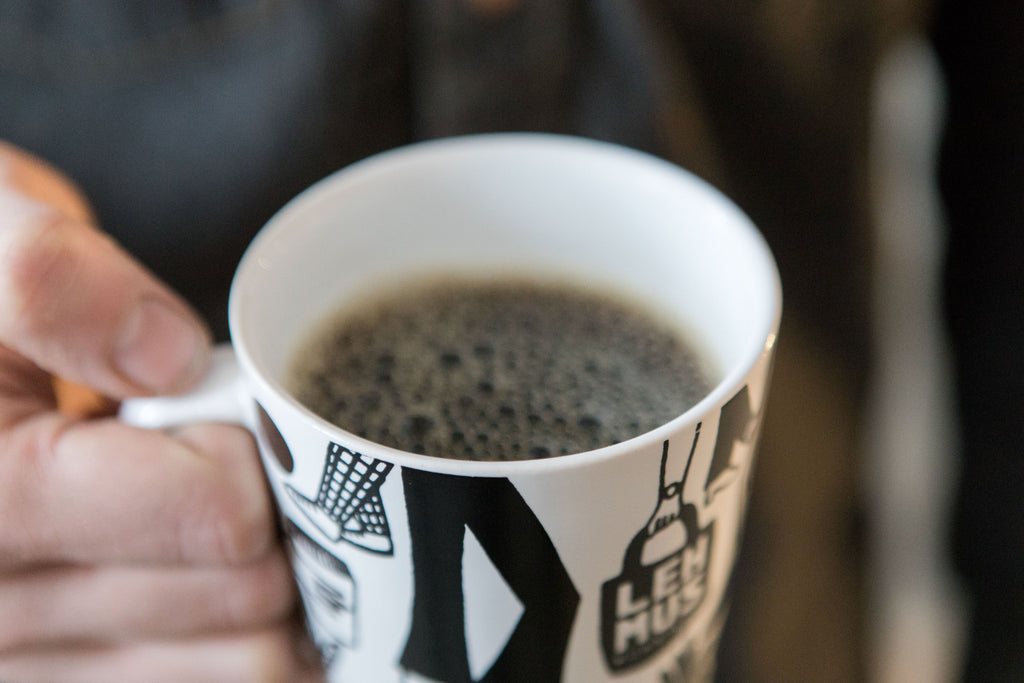
A coffee cup basically has one basic feature. The drink must stay in the cup and it must be drinkable. Also, some kind of handle would be nice.
That's where the simplicity really ends. There is a lot of variation in coffee cups, and they also have different purposes. The espresso cup is small and cute, while at the other extreme are the pint-sized devices that are especially popular with heavy coffee consumers, up to four decibels.
Lehmus Roastery's investigative journalism department delved into the world of coffee cups - and discovered that it is almost as vast as coffee itself.
Material

Ceramics
In Finland, most coffee is drunk from ceramic coffee cups. The Moomin mug, or the 2.6 deciliter mug from Arabia's Teema series, is probably one of the most popular coffee cups.
Lehmus Roastery's own coffee mugs, illustrated by Piia Kedo, are domestically produced. The three-desu cups are made in Lapinlahti. The mouth of the cup is shaped so that it narrows towards the top. This makes the drinking experience pleasant.
Ceramic cups are durable, do not stain easily, and keep drinks hot. The cups usually have a handle large enough to insert your finger or fingers without touching the hot side of the cup.
Glass

In Finland, glass coffee cups are not as popular as in Australia, for example. Some specialty coffees are served in tall glasses. The good thing about glasses is their transparency - the dance of coffee and milk is interesting to watch. Glass also retains heat well in the drink, but the glass may feel too hot in the hands.
Some people enjoy their coffee in a double-walled whiskey glass or tea glass, which prevents the coffee from heating the surface of the glass too much and at the same time allows you to see the beautiful curved shape at the bottom of the glass.
Glass is not as adaptable in shape as a ceramic mug, where there are an almost unimaginable number of options.
Enamel
Enamel mugs are popular for their retro look. Enamel is an opaque glass that is attached to metal. Enamel conducts heat well, which is very noticeable when drinking a hot drink from an enamel mug - the cup is often as hot as the drink itself.
Thermos mug

The thermos mug and bottle are excellent heat insulators. Coffee stays good for a longer time, because in a vacuum, the coffee cannot react with oxygen and the aromas do not evaporate.
Cardboard and plastic

Disposable paper cups, despite their coatings, can leach the taste of cardboard into your coffee. Plastic cups may leach oil compounds into your coffee, so a ceramic or enameled surface is better in such nuanced matters, as they do not leach any flavors into your coffee.
On the other hand, if you need to drink from something, cardboard and plastic containers are also suitable for this purpose.
Form

The shape of a coffee cup has certain practical implications. For specialty coffees such as cappuccino and latte, cups with a curved bottom are used to allow the coffee and milk to mix as evenly as possible.
Cappuccino and latte cups are flat containers. The larger the surface area, the easier it is to draw patterns on the surface of the coffee. Breakfast also plays a role: it is easier to dip a croissant into drinks originally intended for morning coffee when the mouth is large enough.
The mouth of the cup must also be large enough so that the drinker's nose can smell the aromas without making drinking difficult when the spout bumps the edges of the cup.

On the other hand, if you like to enjoy your coffee slowly, you should aim for small mouthpieces. The heat of the coffee evaporates more slowly from a small mouthpiece.
The curvature of the cup also affects how you hold the cup in your hand. A curved cup generally fits better in the palm of your hand than a cup with a completely straight wall. You will see vertical wall cups at many catering events because they are easy to stack.
Coffee flows into the mouth faster along a vertical wall than along a curved surface, so for those who enjoy their coffee slowly, an angle that is too steep may cause a little irritation.
Thickness & mouthfeel

The thicker the rim of the cup, the better it generally insulates heat. On the other hand, the thickness of the mouth, or the top edge of the cup, is also a matter of careful selection. We have determined the appropriate thickness here at Lehmus Roastery as a user test.
It is confusing and enlightening to test different drinking vessels and notice the differences. A thick-rimmed cup (rim thickness 5mm) feels awkward and covers the mouth too much: the drink doesn't seem to flow into the mouth as controlled as you would like.
The regular cup, on the other hand, feels just right - no doubt because a 2-3 mm thick mouth opening is the norm for both Teema and cups from other manufacturers.
A thin wine glass, on the other hand, feels like it could break - you don't get the same feeling when drinking wine from a wine glass. Does the temperature of the drink also affect the sensations?
Surprisingly clear differences also arise from the sensations created by the material of the drinking vessel. A plastic mug feels... plastic. Ceramic, on the other hand, feels suitably sturdy. Cardboard reminds me of a football game and the smell of a grilled sausage.
Color of the inside of the cup

It's a good idea to have a white interior for your coffee cup. White reflects light the most, so the color of the coffee shows up better in a white cup than in a black one.
At our roastery café at Satamatie 6, we serve our filter coffee in Lehmus Roastery's own cup, which has a white interior. We want to make room for the coffee experience itself.
The effect of cup color has been studied, of course. According to an Australian psychology study , color seems to affect the intensity of taste perception. A latte, or brown coffee drink, served from a white cup seemed to taste more intense than coffee consumed from a blue or transparent cup.
A Spanish-English research team came to a similar conclusion after testing how strawberry mousse tasted on a white or black plate. The white color increased the sensation of sweetness in test subjects.
Cup exterior color

In everyday life, a coffee cup can be any color on the outside. As many people who observe mugs at work or at home know, a coffee cup is part of a person's personality and identity. So colors and patterns, texts or lack of patterns are part of a person's essence.
Of course, the cup is also a matter of taste and habit. Many people have their favorite mug, from which coffee tastes best. Associations, traditions and feelings towards a cup are all very good reasons to choose a particular cup. The most important thing is that your fingers or mouth don't get burned.
---
Buy Lehmus Roastery's own coffee mugs here .