
Text and photos: Juuso Viljanen / Uuttaja
When we talk about coffee in the vernacular, we usually mean Arabica coffee (Latin name: Coffea arabica). In addition to Arabica, there is some Robusta (Coffea canephora) on the market, and in very small quantities, the more special Liberica (Coffea liberica). Since probably over 98% of the coffee found in stores in Finland is Arabica, we will focus here on the Arabica sub-varieties.
The background of the name Arabica

Coffee family tree. View the image in large size on the Cafe Imports website here .

The coffee variety itself is known to originate from the Ethiopian highlands, coincidentally from the same region as homo sapiens. It is estimated that as many as 6,000-10,000 different coffee varieties grow naturally in Ethiopia.
Why is coffee then known as coffea arabica? From Ethiopia, coffee was transported by traders through Yemen towards Europe, and that is where the variety's name comes from, even though its origin is on the other side of the Red Sea.
Another interesting name can be found behind the Mocha. For example, Juhla Mocha drinkers may not know that Mocha is a port city in Yemen, and the coffee beans are shipped there from Africa.
Main varieties: Bourbon and Typica

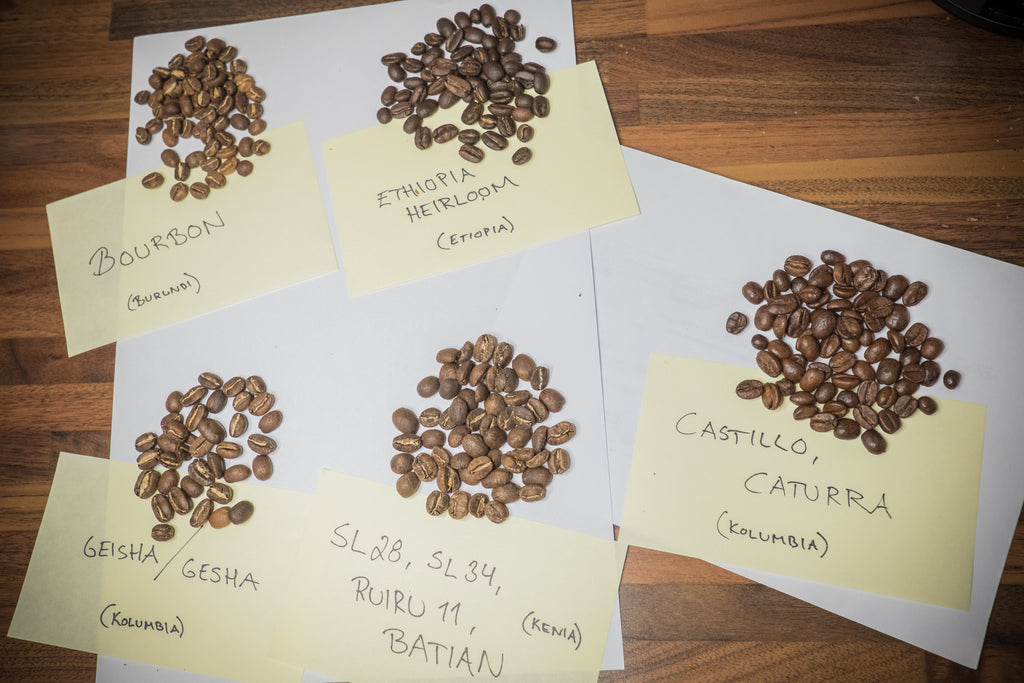
Arabica coffee can be roughly divided into two main varieties: Bourbon and Typica. Typica is often considered the “ancestor” of coffee and is of remarkably high quality. Typica’s taste is characterized by its purity and rich sweetness.
Typica is divided into several sub-varieties, many of which are very local, such as Jamaican Blue Mountain or Hawaiian Kona. In addition, there are sub-varieties such as Kent, Java and Pache, to name a few.
Bourbon is also a high-quality variety, which is also divided into several sub-varieties. In addition, there are many different crosses between Bourbon sub-varieties and other varieties. Bourbon is characterized by its strong aromas and softness. Bourbon is the origin of, for example, Caturra, Pacas, and Yellow, Red, and Pink Bourbon.

When talking about high-quality varieties, Geisha (also called Gesha) has to be mentioned. In every barista championship, there are bound to be several baristas competing who have some truly amazing Geisha coffee at their disposal.
Geisha is characterized by soft fruity and bright floral aromas. Panama is especially known for its Geisha coffee, although excellent Geisha comes from other parts of the world, such as Colombia and its country of origin, Ethiopia.
Natural and laboratory-developed species

There is also a large selection of both naturally occurring crosses and varieties created purely in laboratory conditions. Notable “lab coffees” include the Kenyan SL varieties, such as SL28 and SL34. SL stands for Scott Laboratories.
Their task was to develop a coffee variety that was resistant to plant diseases and would be highly productive. The task went wrong in that regard, but instead they created varieties that were very juicy, often with citrus flavors, a lot of stone fruit aromas, and sweetness. This impressed them and they were put into production.
(You can read Lehmus Roastery's article about Kenyan Kiamugumo washing station coffee, which touches on the background of SL varieties.)
How can species be identified - or does it matter?
Is it possible for a Finnish coffee lover to distinguish the varieties from their cup? Of course it is. There are many differences between the varieties in many different areas, which can be emphasized with a certain type of roasting: fruitiness and sweetness, acidity, mouthfeel, body, and so on.
On the other hand, it is easier to differentiate and identify coffees from different countries and continents. African coffees are typically fruity and berry-like, while South American coffees are more cocoa-like and chocolatey. On the other hand, you have to remember that coffee is produced in a huge area of the world, so coffees from different countries can taste completely different. But you have to start somewhere, so small generalizations are allowed.
When tasting, you have to devote some time and thought to what your nose smells and what kind of observations your taste buds make about the coffee you are tasting. For example, the difference between Geisha and Bourbon can be very clear, as can SL28 and Caturra, for example. You don't have to be a sommelier to notice the differences. But can you name the varieties based on your observations? With hard practice, that's certainly possible.
However, the most important thing is to give quality coffee the attention, time and appreciation it deserves. The skill of recognition and distinction comes after you have first learned the skill of appreciation and calmness.

If you want to delve into the characteristics of different varieties in depth, we recommend the bible of coffee growing, the World Coffee Research website. The Varieties sub-page contains almost all possible coffee varieties and their yield potential, size, disease resistance and the history of the varieties in general. You can spend a day browsing the website!
---
If you want quality, freshly roasted coffee, visit In Lehmus Roastery's online store .