
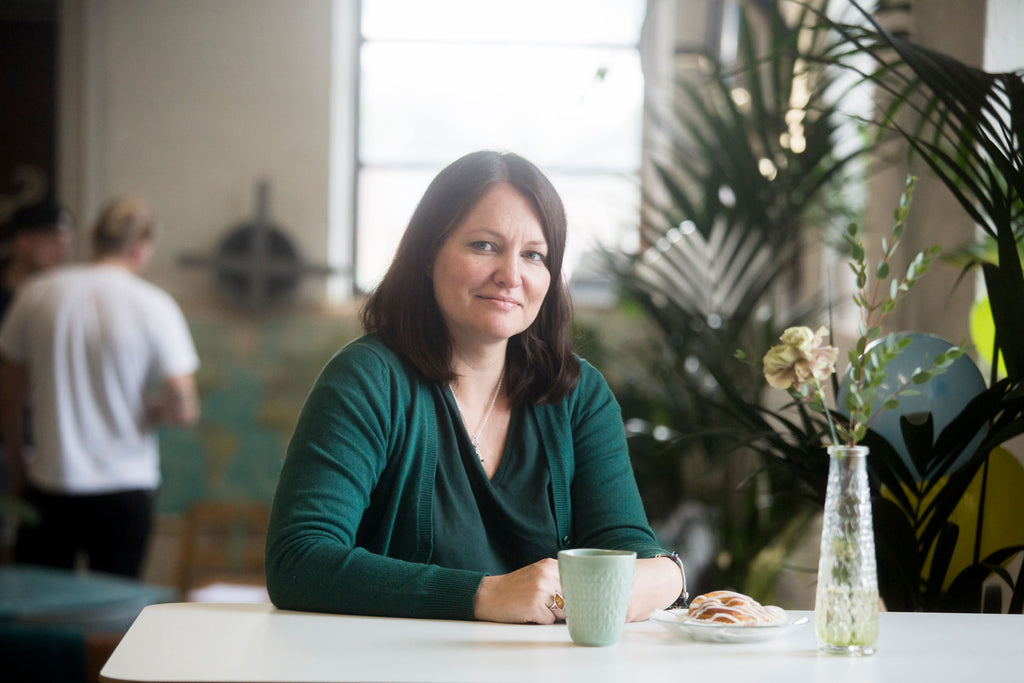
Lehmus Roastery had a very prestigious guest when Teija Lublinkhof visited our roastery this past week. Kuusela Lublinkhof, who lives in Zambia and judges coffee competitions around the world, is originally from Pielavesi, so her visit to Europe naturally led her to Finland to visit her family.
Satamatie 6 also fell on the route, so we gained valuable information and lessons from someone who knows the coffee world well.
You are the head judge of the World Barista Championships, you compete in national competitions, you represent the African Coffee Producers Association internationally, you have the highest possible coffee tasting qualification, and you have founded your own coffee brand in Zambia. How did it all start?
"When I was studying to be a nurse at North Karelia University of Applied Sciences, I was an exchange student in Zambia for a few months. I met my future ex-husband there, whose family had just planted the first coffee bushes on their farm.
After graduating, I worked in London, among other places, but a vacation to Zambia ended up taking me to another place. I had never drunk coffee before, but I took a coffee tasting course and fell in love with coffee right away.
So I started my work by tasting coffee. When the coffee started to produce on the farm, I started doing coffee quality control work in our small lab.
We had visiting trainers and traders, from whom I learned a lot. Coffee is an industry that you don't learn from books, but through practical tasting and doing."

Teija Lublinkof and Visa Tuovinen and Jussi Tyrisevä from Lehmus Roastery got to know the details of raw bean quality control at Lehmus Roastery's roastery.
In addition to all the roasting and coffee farm work, you also organized Zambia's first barista competition and are currently a judge at the world championships. How did you get to this point?
I had actually started tasting coffee and I was training myself in that role. We started roasting coffee, and we had one espresso machine in the corner that no one had touched for the first six months. We had a trainer from Canada who said that we should start training baristas in Zambia to raise awareness about coffee and the importance of coffee quality in general. I thought that I should learn how to make espresso myself so that I could train others.
I brought the best coffee from our farm to this trainer, promising to make espresso from it. I quickly realized that this would not work, as it was far too acidic and salty for espresso - a light roast of Bourbon Arabica, it came through just fine.
The same trainer was involved in the World Barista Championships, so he asked why we didn't organize a national competition in Zambia. So we organized it.

You have also trained extensively yourself, having passed the Coffee Quality Institute's Q Grader Exam, which is the highest possible qualification for coffee tasters. What exactly is that all about?
It's a really demanding test, lasting five days of exams one after the other. The written section is about coffee knowledge, but you also have to be able to identify and name aromas, flavors, flavor levels and blends. So you have to be able to calibrate yourself between tastings, it's not enough to just taste like "black feels good".
One of the most "dreaded" tests is the one with salty, sugary, and sour flavors, and you have to be able to arrange them from weakest to strongest. In addition, you have to recognize how much of each element is present in different mixtures on a certain scale.
You have to do well in the exam. You have to get at least 80 percent correct on all exams, and a full 100 on some tests.
As far as I understand from Finns, I and Paulig's Marja Touri have the Q Grader qualification. The exam requires a lot of experience and coffee tasting.
The test must be renewed every three years to maintain the certificate."
You now judge both national competitions around the world and world championships. How did you get there? Do you have a good sense of taste?
"Yes, I certainly have a keen sense of taste, but of course you have to taste a lot of different coffees from different countries and with different roasts, you have to get a comprehensive understanding of what kind of coffees actually exist and are on the market. Judging is really interesting. You get to see how barista culture is developing around the world, travel a lot and get to taste top coffees."
What things should a judge pay attention to when the competition is coming up?
"During the competition, I will be drinking a lot of coffee compared to usual, so I will start to slowly increase my coffee consumption a couple of weeks before the competition so that I am physically ready to drink a lot of coffee.
I remember how after the first World Championships I must have been in caffeine shock, back then there was no routine like there is now. Nowadays I go to competitions almost every month to be the head judge, so I'm probably a little used to the copious amount of coffee.
"The competition is a serious place, so the judge also needs to prepare well. In addition to the amount of coffee, you need to pay attention to what you eat, as overly spicy foods and similar factors can affect your sense of taste."

What does Finnish coffee culture look like from a global perspective?
"I haven't been following it very closely, but it seems that small roasters are now coming to Finland, which is an international trend. It's also great to see that there are so many different coffees, not just one and the same filter coffee blend."
Finland has traditionally been a very light coffee country. Light coffee cannot be made from bad beans, so Finland has been a high-quality Arabica country in a way. Now in Finland the trend seems to be towards dark roasts. For me personally, coffee is like wine. Different countries produce different types of coffee, even different farms in the same country produce different types of coffee. If the coffee is roasted really dark, the coffee flavors are no longer distinguishable.
We've kind of gone from one extreme to the other, although there's a whole world of coffee flavors in between." (Editor's note: Lehmus Roastery's Kanava is a good start for these light, medium roasts.)
What are the big trends in the world right now?
"Overall, I think that coffee production is moving towards sustainable development, so that just the Fair Trade label is not enough, but we really want a direct connection to the farm. We want to know what conditions the coffee is grown in, and nowadays it is much easier to get information than before. Consumers also want more accurate and direct information, and that is a good thing."
What tips would you give to those planning or developing their own roastery?
"It's important to taste a lot of different coffees and products from different roasters. When you get experience with what's on offer, you can also decide on your own line and the "thing" of your own roastery that you want to take forward. It's not worth just roasting everything possible from A to Z, but deciding which line you want to take and starting to develop it.
What has it been like to be a guest at Lehmus Roastery now?
"Really nice! I haven't spent a lot of time in Finland on the coffee side, this was actually the first time I've trained in Finland. It's fun to see how things are done here - and it's not terribly different from how they roast in Zambia or anywhere else in the world. It's always great to chat about coffee with passionate coffee people."