
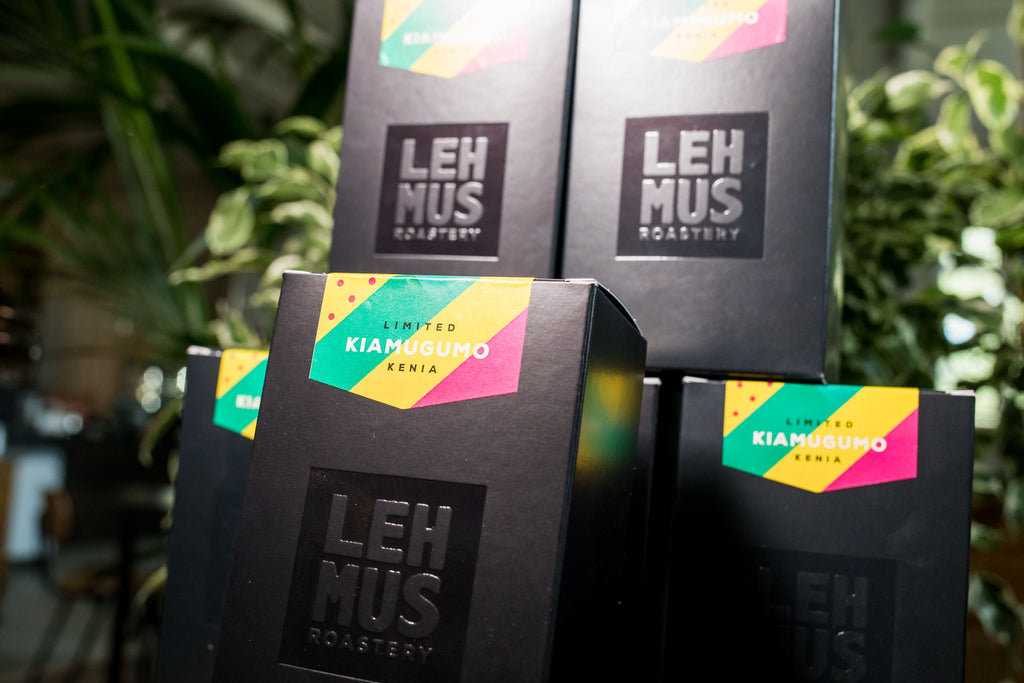
Lehmus Roastery's fresh Limited coffee comes from the Kiamugumo washing station in Kenya. The coffee is produced by small farmers and the varieties in this coffee include the well-known Kenyan SL-28, SL-34, as well as new acquaintances to us Ruiru 11, Batian and K7.
In Kenya, it is typical that the plantations are very small - these coffees are grown by individual families on small plantations of up to ⅛ hectares. One owner may have as few as 150 coffee trees. To give you an idea of the scale, in South America, up to four times as many coffee trees can grow on the same area per hectare.
So, small producers transport the ripe berries to a washing station, which collects the berries, processes them, i.e. separates the pulp and coffee beans, washes, dries and packages the beans, and finally also handles the further sale of the beans.

Limited series continues to delve into special flavors
Limited coffees are small batches at Lehmus Roastery, and we only have two 60-kilo bags of this coffee. They are fresh harvests, as in Kenya the harvest is picked twice a year: the first so-called main harvest is delivered in August-January and the second, so-called after-harvest, is delivered in April-June. This Limited coffee is from the harvest delivered in May-June. So it is practically as fresh as a raw bean can be - although a raw bean can stay reasonably good for over a year, but of course freshness is a value in the entire coffee production chain.
The Kiamugumo washing station is located 137 kilometers north of Nairobi on the slopes of Mount Kenya. The coffee has a pleasantly soft mouthfeel, almost tea-like. The taste is sweet, with notes of currant and mandarin. The acidity is bright and brings out the flavors of the coffee even more.
“If you are not familiar with Kenyan coffees, this is a good coffee to enter the interesting world of Kenyan coffee,” says Jussi Tyrisevä, head roaster at Lehmus Roastery .
The coffee is roasted to its optimum level, i.e. light roast. This way, the coffee brings out its best flavors and aromas. The coffee was roasted in several different tests to ensure the best possible coffee profile.
“In light coffee, you don't taste the roastiness, but only the flavors encoded by nature in the bean. That's what makes roasting special batches like this interesting,” Tyrisevä says.

The backgrounds behind the unique names of Kenyan coffee varieties
Our Limited coffees include SL-28, SL-34, Ruiru 11, Batian and K7. To understand the names of the varieties, we need to go back a little in history.
Although Kenya is located next to Ethiopia on the map, Kenya does not have as long a history of coffee cultivation as Ethiopia. While Ethiopia is known as the birthplace of the coffee plant, coffee has only been grown in Kenya for about 300 years. Coffee was brought to the country by Scottish and French missionaries. The Scots brought coffee varieties from Yemen and the French from the island of Réunion in the Indian Ocean. The island was previously known as Bourbon and this island is where South American coffee varieties originated.
Due to their origin, Kenyan coffees differ from their Ethiopian counterparts in terms of flavor profile. Kenyan coffees are typically acidic and raisiny, while Ethiopians are known for their more fruity and sweetly smooth coffees. Coffee began to grow well in Kenya, as the slopes of Mount Kenya have very fertile soil.

Perhaps the best-known Kenyan varieties, SL-28 and SL-34, trace their roots back to Scot Laboratories, which was hired in Kenya in the 1930s to develop Kenyan coffee beans for the best possible quality and efficiency in terms of cultivation area.
SL scientists selected 40 different coffee trees for testing, which were named and numbered starting from SL-1 and continuing to SL:40. Of these, numbers 28 and 34 have emerged as the best.
Ruiru 11 is a variety that was only developed in the 1980s, and is a combination of Timor Hybrid and Rume Sudan varieties. It is highly resistant to coffee berry disease that affects the soil and is therefore a good production coffee. Batian is a cross between SL-28 and SL-34, as well as other Kenyan coffees. It grows large and produces a good harvest, but it is also highly resistant to diseases - making it a good variety to grow alongside other cultivated plants.
The last Limited coffee variety is K7, which is a variety developed from SL coffees and is related to Bourbon coffee. Bourbon is a typical coffee in South America. In Africa, K7 is only grown in Kenya and Tanzania.

Origin: Kenya
Area of Origin: Gariama, Manyatta, Kirinyaga
Washing station: Kiamugumo
Varieties: SL-28, SL-34, Ruiru 11, Batian, K7
Processing: Washed
Growth altitude: 1550 m
Harvest season: May-June
Order coffee to your home here! (Editor's note: product sold out and link to product removed.) See the current Top Shelf selection here !
Price:
€13.90 / 200g
€35.90 / 600g
€49.90 / 1000g
The coffees are delivered in 200g packages.
(Price per kilo €49.90 - €69.50/kg)