
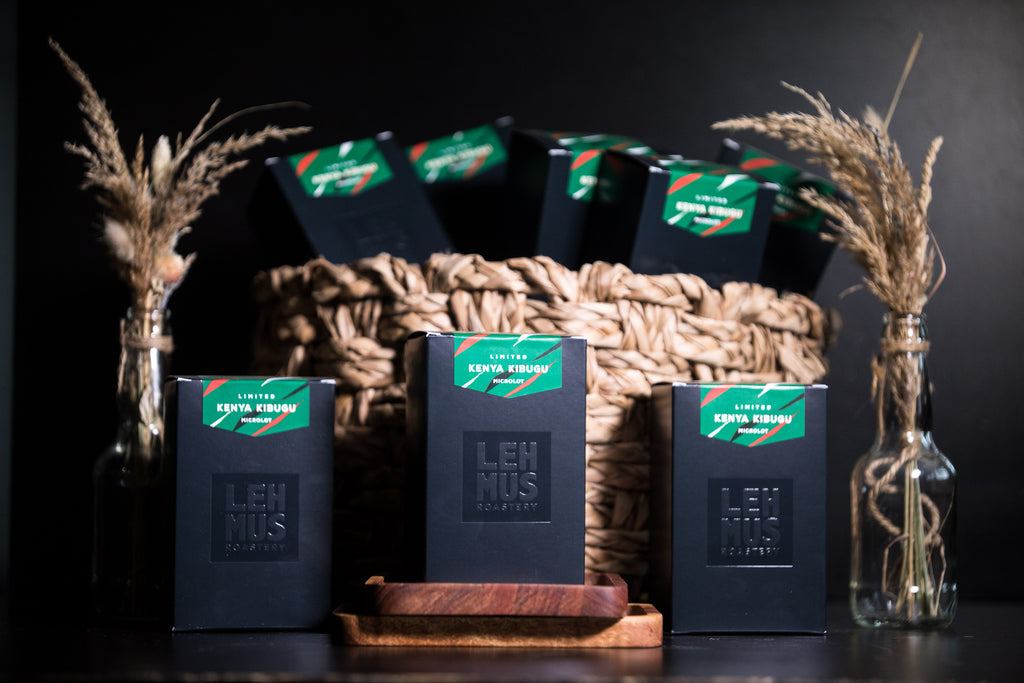
Could it be a crisp, sweet and gentle micro-batch from a very fresh harvest from Kenya? And a coffee that only exists in 120 kilos – a very limited batch, that is.
If you're interested, keep reading. We have something for you, namely the newly launched Limited Kenya Kibugu Microlot.
Our Limited Edition coffees represent special batches from around the coffee-growing world. This time, after extensive tasting and experimenting with alternatives, we settled on a micro-batch from the Kibugu farming community in Kenya, and what an interesting coffee we found there!
Top coffee from really small farms

The Kibugu coffee community includes no fewer than 1,050 farmers. Although "farmer" is a bit of a lofty term in this case, as the majority of farmers manage plantations of 1,250-2,500 square meters high in the Embu highlands.
Why this coffee? At Limited, it is important to us that the coffee tastes good, but many things affect the taste. Of course, the conditions of the harvest season, the vitality of the coffee bushes, picking the berries when ripe, and high-quality processing are essential. The processing plays a significant role: the berries and thus the coffee beans (i.e. the seeds of the coffee berry) can be spoiled in post-processing, just as roasting can either bring out the aromas of the coffee or not.
All of this small batch is carried out in the following way. Farmers bring the coffee berries to a common processing station on the same day they are picked. The pulp is then removed from the berries and the beans are sorted and separated. The coffees are then fermented in water barrels for 24 hours, i.e. a short fermentation is carried out. After this treatment, the excess pulp and surfaces are washed off the beans. Once the beans have been washed, they are left to dry for a week to two weeks.
Limited Kenya Kibugu tastes soft sweet citrusy

The Limited Kenya Kibugu package is inspired by the colors of the Kenyan flag.

The coffee beans are small but full of aromas. Limited coffee is roasted between light and medium roast, so that the coffee's own aromas are at their strongest. In other words, we avoid the roastiness of dark coffees and the bitterness of coffees that are too light.
This treatment gives Limited Kenya Kibugu a sweet, soft, full-bodied taste, but still characteristically Kenyan coffee, i.e. a refreshing freshness. Citrus aromas are also present in this specialty. Our tasters detected lemon and blood grapefruit, among others. A pleasant coffee in every way.
The coffee bushes grow at an altitude of 1550 meters, which is very high, so to speak. The varieties are typical Kenyan varieties, namely SL-28, SL-34, Batian, Ruiru 11 and K7.
You can find more about the history of Kenyan varieties in our old Limited coffee article, but let's copy it here as well:
The history of Kenyan coffee farming

"Although Kenya is located next to Ethiopia on the map, Kenya does not have as long a history of coffee cultivation as Ethiopia. While Ethiopia is known as the birthplace of the coffee plant, coffee has only been grown in Kenya for about 300 years. Coffee was brought to the country by Scottish and French missionaries. The Scots brought coffee varieties from Yemen and the French from the island of Réunion in the Indian Ocean. Previously, the island was known as Bourbon, and this island is where South American coffee varieties originated.

Due to their origin, Kenyan coffees differ from their Ethiopian counterparts in terms of flavor profile. Kenyan coffees are typically acidic and raisiny, while Ethiopians are known for their more fruity and sweetly smooth coffees. Coffee began to grow well in Kenya, as the slopes of Mount Kenya have very fertile soil.
Perhaps the best-known Kenyan varieties, SL-28 and SL-34, trace their roots back to Scot Laboratories, which was hired in Kenya in the 1930s to develop Kenyan coffee beans for the best possible quality and efficiency in terms of cultivation area.
SL scientists selected 40 different coffee trees for testing, which were named and numbered starting from SL-1 and continuing to SL:40. Of these, numbers 28 and 34 have emerged as the best.
Ruiru 11 is a variety that was only developed in the 1980s, and is a combination of Timor Hybrid and Rume Sudan varieties. It is highly resistant to coffee berry disease that affects the soil and is therefore a good production coffee. Batian is a cross between SL-28 and SL-34, as well as other Kenyan coffees. It grows large and produces a good harvest, but it is also highly resistant to diseases - making it a good variety to grow alongside other cultivated plants.
The last Limited coffee variety is K7, which is a variety developed from SL coffees and is related to Bourbon coffee. Bourbon is a typical coffee in South America. In Africa, K7 is only grown in Kenya and Tanzania."
Order Limited Kenya Kibugu Microlot for €15.90/200g here. (Editor's note: product sold out and link removed.) Check out the current Top Shelf selection here !