
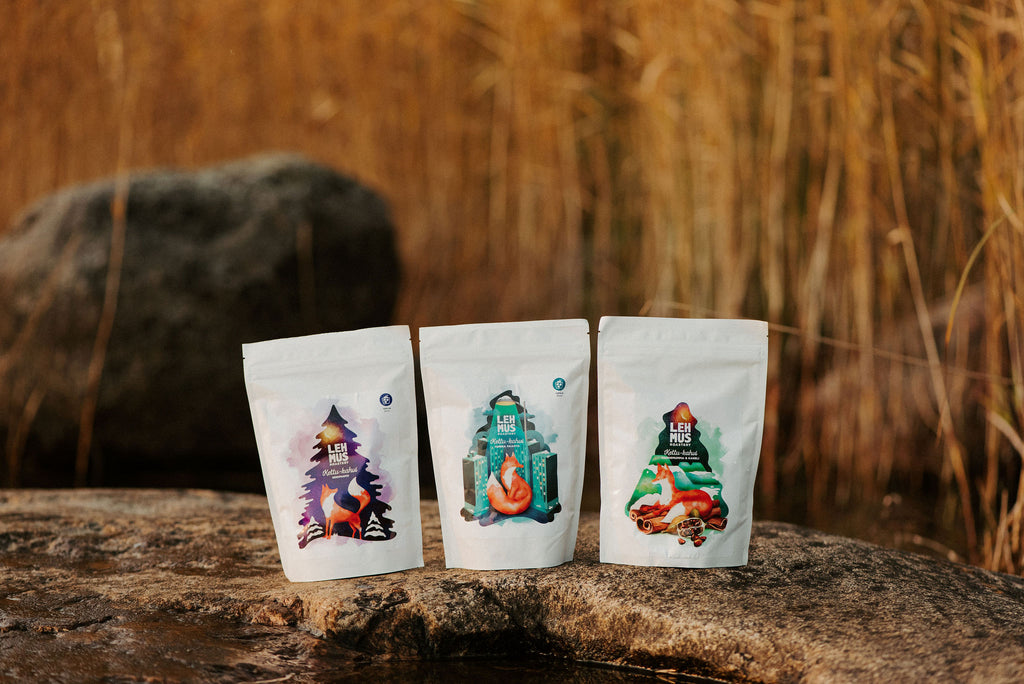
Lehmus Roastery's popular Kettu coffees can be found on store shelves and in the Lehmus Roastery online store again. This year we also have a new tea drink, a spicy chai called Repotee. You can find more information about Repotee in this article .
Kettu coffees start the autumn and winter season at the roastery. The aromas of the favorite coffees are nutty and chocolatey, and there is also a light fruitiness that lingers in the mouth.
This year, we will also be offering three Kettu coffees: medium roast Kettu, dark Kettu and Maustekettu. In addition to coffee, the aromas of Maustekettu include cardamom and Ceylon cinnamon.
(Photos of fox coffee: NXM Foto )


Kettu coffees were inspired by the city foxes of Lappeenranta, who live in the hiding places of the fortress ramparts. In the first autumn, foxes also roamed around our roastery and stared in through the windows of our roastery in the evenings. So we christened our winter coffees Kettu coffees.
The following year, we roasted a dark-roasted City Kettu coffee to accompany the first Kettu coffee, and the following year, the spicy Mauste-Kettu coffee arrived in our selection straight from the fortress's rear ramparts.
This year, the Kettu family expanded to the tea side, when chai-flavored Repotee found its way to our roastery.
Award-winning Fazenda IP focuses on high quality

Luiz Paulo and Lehmus Roastery's Arttu Muukkonen on the slopes of Fazenda IP in autumn 2019. A notebook peeks out of Luiz Paulo's breast pocket, in which Luiz Paulo writes down the identification numbers, processing, conditions, scores and other identifiers of all coffee batches. The office has several cardboard-boxed notebooks full of text and coffee information from past years. Photo: Samu Koskinen
This year, Kettu coffees come from the Fazenda IP family farm. We met farmer Luiz Paulo Dias Pereira last fall when we visited their farm in Carmo de Minas, Brazil.
Fazenda IP The history dates back to 1967, when Luiz Paulo's father bought a small farm in the mountainous countryside. Five years later, Luiz Paulo joined after completing his studies in agricultural science.
In 1974, when Luiz Paulo was 22 years old, they decided to buy more land around the farm and plant more coffee bushes. Over the years, other family members have also acquired coffee plantations on the nearby slopes, and today the entire area is cultivated by the Pereira family.
In itself, Fazenda IP can be considered a kind of dynamo or heart of the Carmo des Minas area: neighboring plantations use their processing station, Luiz's siblings and relatives cultivate their own farms, and Luiz Paulo's son , Luiz Paulo Junior, has founded Carmo Coffees, with which Lehmus Roastery collaborates and through which we purchase the majority of our Brazilian specialty coffee.
For 13 years, Carmo Coffees has been developing and training farmers in the region with the goal of obtaining specialty coffee-level quality from Brazilian production, known as bulk coffee.
Fazenda IP is known in their region as a farm that annually collects awards in various coffee competitions. This year, over 70% of their specialty coffees achieved at least 84 points in the cupping score: in layman's terms, this means that the quality of the coffee they grow is of a very high standard.
"We put a lot of time and effort into the processing. So much that you wouldn't necessarily believe it. But that's how we achieve high quality."
 Fazenda IP has its own processing station. Very small farms transport their coffee to shared stations. Fazenda IP's station also processes coffee berries from nearby farms. Photo: Arttu Muukkonen

Especially in the last six years, under the leadership of Luiz Paulo, the farm has focused on developing the quality of specialty coffee production, as improving quality also has a direct connection to the compensation the farmer receives for the coffee. The work requires humility and a willingness to be diligent.
"Even though every year we think we already know quite a bit about how to do this job, when the new crop ripens we are surprised that we still don't know much about anything. Of course, that keeps the job interesting."
Today, Fazenda IP employs around 30 people year-round and up to 80 during harvest time.
Why are the coffees so brightly nutty and chocolatey in their aromas? The taste is not only the result of hard work, but also the soil and climate. Fazenda IP's volcanic soil is fertile and the valley's microclimate provides optimal growing conditions for the coffee.

Fazenda IP's farm spreads out over the mountain slopes. The red color refers to the high amount of iron in the soil. Photo: Arttu Muukkonen
The relatively high altitude of Brazil, 950-1200 meters, offers the opportunity for selective picking, whereby coffee berries are only picked when ripe. This way, the quality of the coffee remains high.
How does Luiz Paulo feel knowing that there is a small town in northern Europe whose roastery receives all of its winter coffee from Luiz Paulo's farm?
"We are really proud that our coffees, which we have grown with hard work and care, are suitable for customers across the ocean. We are really proud. There are no words to describe it."
Kettu coffees:
Country: Brazil
Region: Minas Gerais, Carmo de Minas
Status: Fazenda IP
Grower: Luiz Paulo Dias Pereira
Variety: Yellow Bourbon Arabica
Processing: Natural or sun-dried
In the taste:
Medium roast Kettu: nutty, cocoa notes
Dark Roasted Fox: Roasted walnuts, dark chocolate
Spiced: Cardamom, cinnamon, soft mouthfeel, full-bodied
Kettu coffees in the online store (Editor's note: link removed after the coffees were removed from sale.)