
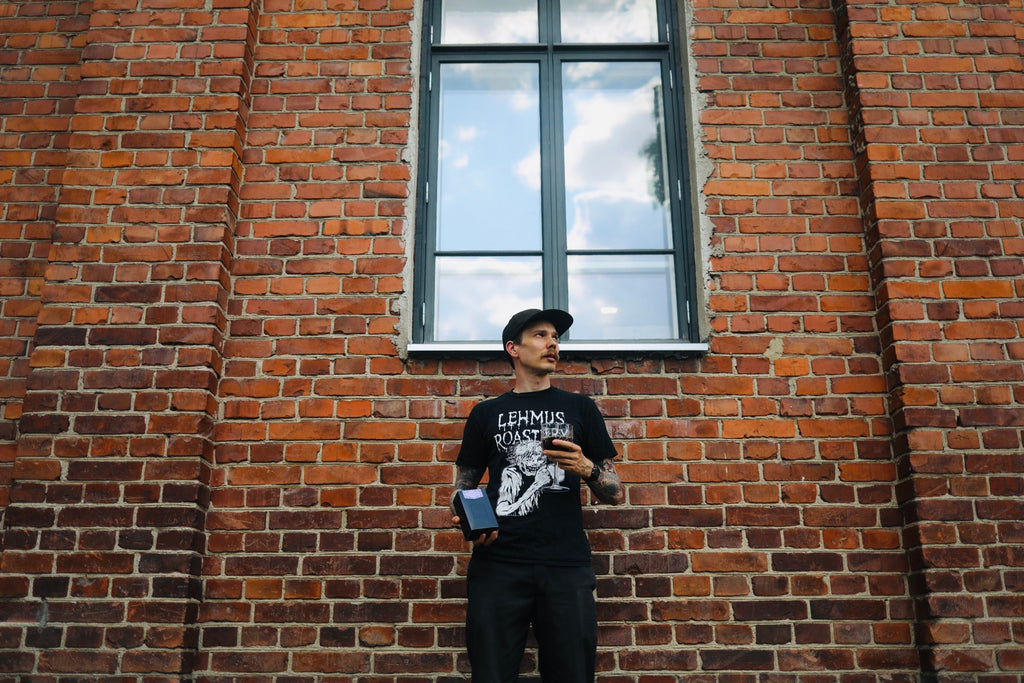
Lehmus Roastery won the Filter Coffee of the Year competition for the second time at the Helsinki Coffee Festival last month. In the 2023 competition, the blind tasters and jury were charmed by Limited Nestor Lasso Colombia, in 2021 the competition was won by Limited Negele Gorbitu Ethiopia. We also achieved success in 2018, when we achieved second place in the competition with Limited Geisha 1928 Ethiopia.
Both winning coffees have been coffees that have undergone multi-layered processing. Processing refers to the stage when the coffee berries have been picked and are being peeled to clean the seeds, or coffee beans, inside the berries for roasting.
In recent years, anaerobic fermentation, or anaerobic fermentation, has been the secret to the success of many competition-winning coffees. Anaerobic fermentation refers to various processing methods that cause a fermentation reaction in the coffee berry. In this case, bacteria and yeasts in the pulp get to work, so to speak, and create various aromas, which also leave flavors in the coffee beans themselves. The most common form of fermentation is immersing the berries in an airtight water tank. In addition, coffee berries can be stored in plastic bags in a cool place for a while, rinsed alternately with hot and cold water, and returned to the bags. The final method of drying the berries can also be either directly in the sun (the fastest) or in a temperature- and humidity-controlled drying room (the slower method). All of these methods affect the taste of the coffee in different ways.
After processing, the coffee can have tropical fruit aromas, rum-like notes, general alcoholism, and other aromas that do not fit into the realm of traditional coffee, or mocha aromas. Some consider anaerobically fermented coffees to be flawed, but the majority appreciate the wild and exciting flavors of coffees processed in this way.
These treatments also include Lehmus Roastery's 2023 filter coffee, Limited Nestor Lasso Colombia. The name Limited refers to the availability of the coffee, meaning it is a very limited small batch. (This is also why competition coffees are relatively low in availability: top batches are small, tens or at most hundreds of kilos, so at the moment of success they disappear from the shelves quickly.)
Nestor Lasso is a 24-year-old farmer whose coffee won the 2022 World Barista Championship. The innovative farmer has quickly raised his profile in the coffee world, and this year his coffee also won the Filter Coffee of the Year competition. Nestor Lasso also took second place, as Helsinki-based Kaffa Roastery came in second with coffee from the same farmer.
The competition coffee was roasted by Lehmus Roastery's head roaster Jussi Tyrisevä . Tyrisevä, who has worked at Lehmus Roastery for six years, is responsible for roasting new coffees, and thus this coffee also got its taste through Jussi's hands.

Jussi Tyrisevä, how does the design of these small-batch coffees begin? What happens when the raw beans arrive at your table?
- We start to get to know them in the same way as all other coffees. We make small test roasts with our tabletop test roaster. Then we taste them with a group and evaluate how the roasts are developed. Test roasting helps us evaluate the starting points for the coffee, and how it should be roasted to get the best flavors out of it.
In this case, aging was also monitored with test roasts. Complexly processed coffees are not necessarily at their best immediately after roasting, but the optimal flavor can develop weeks after roasting. We also monitored this weekly in this case.
Once the flavor is found, the same grinding cycle is done on a large production roaster. A few different profiles are made and compared. Often, small differences in roasting can make significant differences in flavor intensity.
How does the roasting of these specially processed coffees differ from that of the basic line coffees? That is, the ones that are roasted in thousands of kilos per year?
- Fermented coffees are a bit more challenging to roast. They may be more prone to developing a certain charred taste at the end of the roast. If we compare them to our heavily roasted Brazilian coffees, there are more opportunities to emphasize different aspects of the taste: whether we want to emphasize brightness and acidity in the taste or bring more fullness and so-called funky flavors.
How many grinding cycles did the coffee require?
- Basically, we made three candidates, one of which we decided to take forward. We made slightly different versions of that coffee, and it ended up as our competition coffee.
Was there something in the coffee that affected the roasting?
- Yes, that special processing does have an effect. Fermentation changes the physical structure of the bean compared to more traditionally processed coffees. It behaves differently when roasted and extracted, and this must be taken into account, for example, in the grind size.
Is roasting such small batches stressful? There is not too much raw material and the roasting has to be done well, preferably all at once.
- If it's a terribly difficult profile, and its repeatability is difficult or weak, then it starts to become a burden. In this coffee, the repeatability was relatively consistent.
Did you know that coffee goes to competitions? Does that affect the roasting?
- Of course, it was known that the Limited, which is being launched at this point in the year, will also be used for competitions. It is difficult to assess whether it will be successful or not. From the roaster's perspective, the most important thing is of course that the coffee is made as well as possible. Competition success in itself is not the deciding factor, but good-tasting coffee.
At some point, when the roast level and profile are locked in, it has to be as good as it can possibly be. And of course, you can always tweak it a bit and improve the flavor if needed.
---
Limited Nestor Lasso is guaranteed to be on sale in our online store and in the Satamatie 6 store while supplies last.