
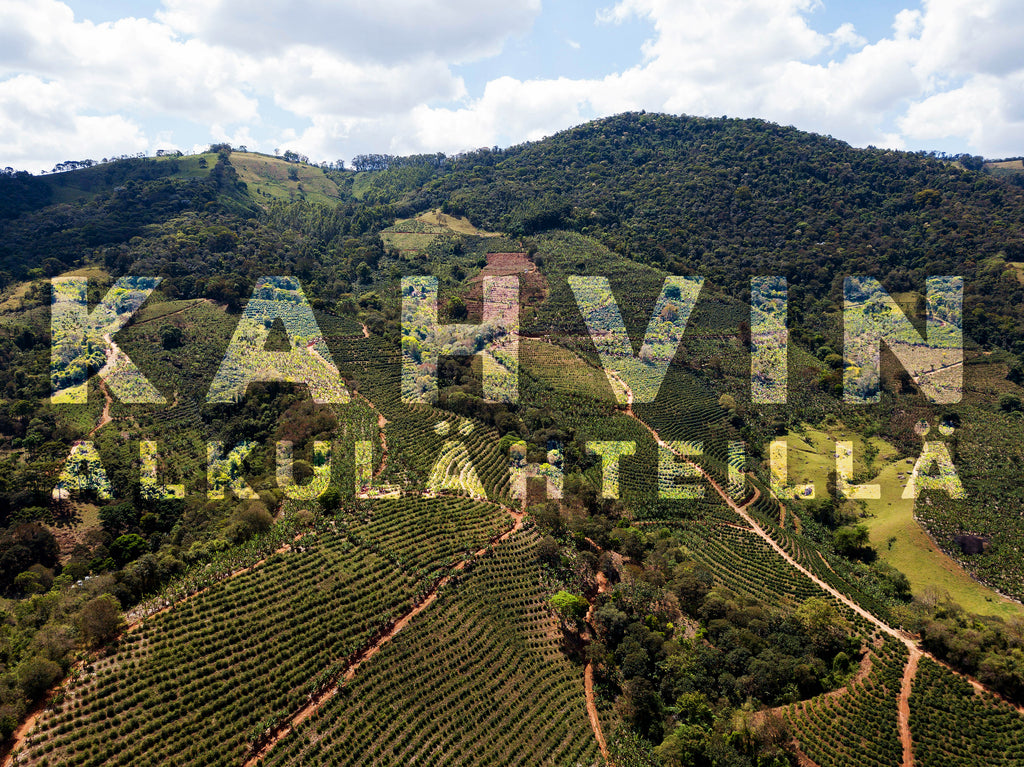
In October, we visited the small farm in Santa Catarina, southern Brazil, shown in the picture. On the farm, bananas protect the coffee bushes and the neighbors think the farmer who focuses on specialty coffee is a bit crazy. Coffee is grown here for Lehmus Roastery's Kettu coffees.
Photos and text: Arttu Muukkonen
We are hurtling up a steep mountainside in a small pickup truck. We are in the southern Brazilian province of Pedralva. The red dirt road is dusty under the four-wheel drive as giant banana leaves try to hit the shoulders of those sitting on the platform.
Coffee bushes can be glimpsed behind the broad foliage. The varieties are Yellow Bourbon and Catuai, our local guides expertly tell us. We ourselves cannot yet quite identify the varieties from the leaves alone.

The soil in Pedralva is reddish due to its abundance of iron.
In a pickup truck.
Brazil is incredibly green and nature is almost noisy. Birds chirp and chirp, there is a hustle and bustle by the roadside. October is the beginning of spring, and the coffee bushes are already blooming. The drive ends when the road ends.
We have climbed a couple of hundred meters out of the valley. We are now standing at an altitude of about 1400 meters above sea level. In front of us are views of the southwestern corner of the world's most important coffee producing region, Minas Gerais. We are above the small plantations of Santa Catarina.
A lifetime of coffee

Sebastião Alexandre Silva farms the Santa Catarina farm together with his nephew José Rodrigo Silva Pimienta.
A man in a Stetson jumps out of the driver's seat of a pickup truck. He is Sebastião Alexandre Silva , a 44-year-old coffee farmer. The coffees from Silva's farm are used in Lehmus Roastery's Kettu coffees. Coffee since the age of 17 Silva is a third-generation farmer.
Previously, his family only grew coffee as a side product, but now coffee is Silva's main product. At first, the Santa Catarina farm was full of bananas, but year after year Silva increased the proportion of coffee on the mountain slopes. Over the years, he has sold the bananas and invested the money in coffee farming.
Today, the five-hectare farm is full of coffee, and the banana trees serve as windbreaks and shade for the coffee. Growing bananas also provides another source of income: coffee grows slowly, and its cultivation ties up money.

Aerial view of Citio Santa Catarina.

The slopes of the Pedralva Valley are lush with spring greenery. Banana trees can be seen in the foreground, and coffee bushes can also be seen in the background.
Cheap coffee is not worth it

Samu Koskinen from Lehmus Roastery explores naturally processed, or sun-dried, coffee.
Coffee farming has long been a low-profit business in Brazil. The world market price of coffee has long remained so low that it barely covers production costs. The average age of coffee farmers is increasing, as the work is hard and completely dependent on the weather.
It has not been among the trendiest professions, just as farming is not necessarily in Finland. Specialty coffee, i.e. coffee grown and processed with special attention, offers farmers the opportunity to receive fair compensation for their coffee. For example, Lehmus Roastery pays about four to five times the price of stock market prices and more than double the price of fair trade certified coffees. With better compensation, farmers can focus on nurturing quality.
 Sebastião Alexandre Silva turns coffee beans on the concrete patio of his farm. In sun-drying, coffee berries are turned several times a day to ensure that the coffee dries evenly.

The same small processing station at the Santa Catarina farm from the air. The highest quality, so-called microlot coffee, is dried on raised beds. The lowest quality coffee, which is not even sold abroad, is visible on the upper right side of the patio. All the raw and otherwise defective berries have been collected there.
The berries of premium coffees are only picked when ripe. Previously, pickers could pick and shake off all the berries from the coffee bush at once, which included both completely unripe berries and slightly overripe berries. The work was easier and the harvest was harvested at once. At the same time, compensation for the coffee also came at once.
Nowadays, as specialty coffee becomes more popular, farmers are hiring pickers for longer periods of time. Picking is done throughout the harvest season. It is more expensive, but the quality is also higher. When people are willing to pay more for coffee, the farmer also has more money left over. Specialty coffee is one path towards more sustainable coffee consumption.
The quality of Silva's coffees has risen to a high level in just a few years.

Sebastião Silva has also been aiming for specialty coffee classification at his Santa Catarina farm. The biggest change he made four years ago was when Silva began collaborating with the Pedra Branca processing station.
Pedra Branca is an investment by Carmo Coffee, a specialty coffee company representing local farmers. It was revealed that the coffee grown on Silva's farm was of very high quality, but the post-harvest processing was not yet at a high enough – or time-consuming – level to earn the title of specialty coffee.

Calixto Peliciari stands at the receiving basin of the processing station.
A year ago, Silva and Calixto Peliciari, who had become the new farmer liaison at the Pedra Branca processing station, got to work. Peliciari had extensive experience with specialty coffee and the processing methods it required.
He had noticed that Silva was interested in developing his production, but there were still steps to climb – if Silva just wanted to work.
"We started paying attention to the processing methods and started doing different experiments. At first, Sebastiao was a little nervous about what would happen, but when the price of coffee rose to a high level at the auction, he began to believe in this method of operation."

The coffees are in the final stages of their drying process on the drying beds at the Pedra Branca processing station. The beans are turned by hand several times a day to prevent moisture from accumulating.
Silva nods next to him. Last year, Silva's special batch of coffee made it into the top 30 at the region's most important auction, and this year Silva was already in the top 15.
Coffee is a traditional industry, so other plantations considered Silva crazy when he started looking for quality instead of quantity.
“The neighbors thought I was crazy. Of course the old way was faster and easier, but of course this quality development is more interesting, although much more demanding.”
Kettu Coffees are responsibly grown specialty coffees.
 Kettu coffee packages where the Kettu coffee beans come from, that is, hanging out around the corner from Beneficio Pedra Branca station in southern Brazil.
Lehmus Roastery buys its Kettu coffee from Pedra Branca and other coffees directly from Silva's farm. Coffees with the same flavor profile are collected from farmers in the same valley at the processing station, which are then blended into a regional blend. The coffee is a Yellow Bourbon variety with a chocolate and caramel flavor. The coffee is fresh and sweet.
Silva and his family have always lived in the Pedralva region. How does it feel when his coffees will soon be sizzling in Kettu coffee packages all over Finland?
“We feel a great responsibility when we know that our coffee is being sold there. Of course, it is also great to see that our work is appreciated when people want to buy our coffees. Finland itself is not a very familiar country, I know that it is cold there and that Kimi Räikkönen is from there,” Silva says.
 Lehmus Roastery's Samu Koskinen and coffee farmer Sebastião Alexandre Silva lounging on Silva's farm.
--
Order Kettu coffees from our online store or buy them from well-stocked grocery stores and coffee specialty shops.