
In this decade, more and more people have started making coffee at home, as break rooms in many workplaces have completely or partially changed to home offices.
At the same time, more attention has been paid to coffee brewing. Sales of Wilfa electric grinders are growing rapidly, and online sales are booming among small Finnish roasters. Everyone wants to drink good coffee instead of cheap coffee!
But how do you get access to these special coffees? Why are they a little more expensive than bulk?
Coffee is a bit like wine. There are regions, varieties, farms, and continents. Not to mention processing, roasting degrees, and extraction methods.
Professionals talk to each other about Burundian washing stations and the effects of growing conditions on the eastern slope on coffee acidity, while the average coffee drinker would just like to know what coffee is good and where to get it.
So it's time to launch the best possible guide to the world of small roastery coffee! Lehmus Roastery offers its helping hand and takes you in with a gentle touch. Let's embark on a journey towards better coffee!

First question: why should you buy coffee from a small roaster?
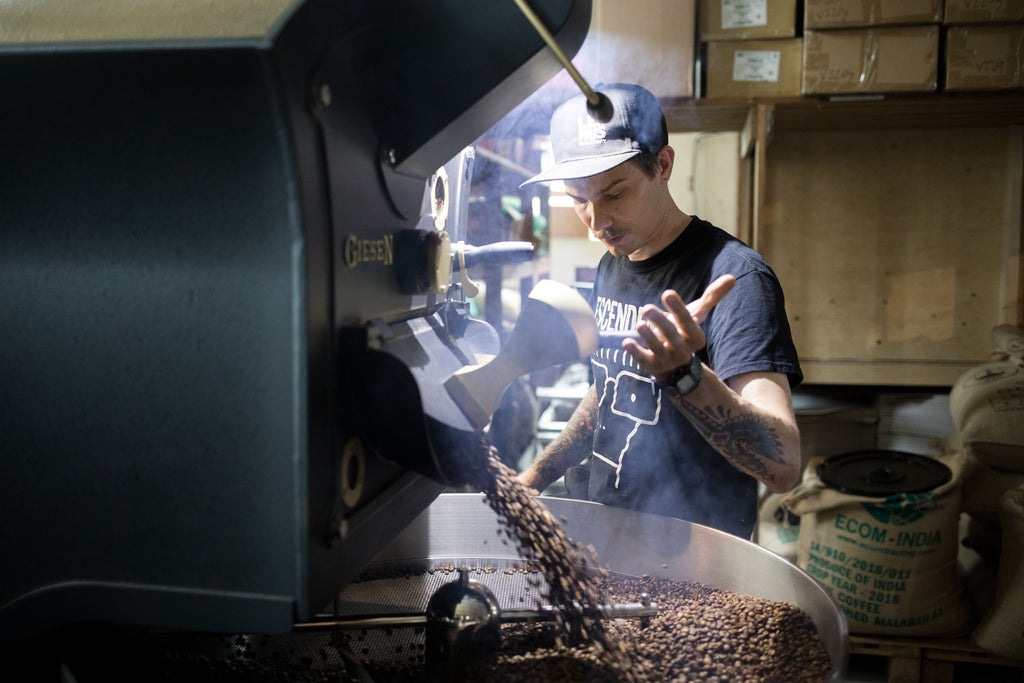
Because coffee from small roasters tastes very good. Usually, the aromas of coffee roasted by hand by a small roaster are remarkably strong, whether it is light or dark coffee. This is because the coffee beans used are of high quality.
The coffees used by high-quality small roasters grow high on the slopes of mountains in fertile soil. The coffee berries are hand-picked when they are ripe – there are no unripe ones. The coffee batches are carefully cleaned, so no branches or debris get into the roaster. The coffee beans are of uniform size, so they roast evenly. The beans are also roasted slowly by hand, which gives the flavors time to mature and brings out a lot of flavor from the coffee.
Small roasters also know the farmers: the coffees are usually blends from either one farm or small farmers in one region. That's why small roaster coffees usually have the name of the producer on them: the difference from having 100% Arabica on the side of the package is huge.
It's a different thing to buy, say, potatoes from Lensu Farm at Lemi than to buy "100% potatoes."
Small roasters offer regular, good quality coffees. In addition, most roasters also offer really special and unique flavors, such as coffee that tastes like tropical fruits. The world of coffee flavors is incredibly wide. These most special and exciting flavors are not found in the selections of large roasters.
But why are small roaster coffees so valuable?
Whenever things are done right, it is a little more expensive. So again, it is about the raw material and craftsmanship. Green coffee beans purchased from small roasters are significantly more expensive than beans from large mass roasters, typically up to 2-6 times more expensive.
In coffee, quality and price go hand in hand: usually, an expensive bean is also tastier. High-quality beans are grown in small quantities. They are hand-picked when ripe, so harvesting is a labor-intensive contract. Processing and separating the coffee berries is demanding and time-consuming work. But it is worth the effort: the farmer receives fair compensation for high-quality coffee.
Currently, the world market price of publicly traded green coffee is so low that farmers may not be able to cover their costs with that price. Small roasters pay a premium for the coffee, which allows farmers to make a living from their work and make investments to improve working and growing conditions on the farm.
Secondly, it is pointless to compete with large roasters on price, so small roasters focus on quality. At small roasters, everything is done by hand: roasting, grinding coffee from beans to powder, packaging, labeling... Not to mention continuous product development, testing new roasting profiles or recipes, and searching for small batches and developing collaborative projects. Large roasters produce the same stuff year after year in bulk.
Thirdly, in Finland, coffee is for some reason a throw-away product in supermarkets, and it is sold super cheaply. It is telling that small roasters cannot even buy green coffee at the same price that stores sell bulk coffee.

How can I choose the right coffees for myself?
First, you need to think about what kind of coffee you usually like. Are your favorites really dark, really light, medium roast, or something else?
Dark roast coffees are an easy way to get to know small roasters.
Most Finns start their journey to small roasteries with dark roasts. Dark roast coffees are roasted darker than usual, meaning the beans have been in the roaster's drum for a long time, allowing more water to evaporate and the coffee's flavor to begin to develop a roasted flavor. Dark roasts are also generally softer than usual, meaning the coffee has very little natural acidity.
If the coffee is of high quality, it will have plenty of aromas even when dark. Milk or oat drink also goes well with dark coffee, so you can't go wrong with dark ones. Of course, it's worth looking at the roast level. Roast levels are usually marked on a scale of 1–5, but it's not a uniform scale. At one roastery, a four roast level may be the same as at another's five.
Among the Lehmus Roastery selections, Pusupuisto, for example, is considered by many to be suitably dark, but Lauritsala is also suitable for dark lovers. On the other hand,Sammonlahti , which is a 5/5 on our roasting scale, was originally intended as an espresso coffee, and the proportion of Robusta beans in it brings its own ashy taste. However, many people order this because the coffee really does have a taste.

Medium roasts are often pleasant and versatile coffees.
Medium roast coffees are often easy and safe choices. Of course, you have to take into account that different roasters define roast levels independently. Medium roasts are around 2.5–3 in roast level, when the scale is 1–5.
Medium-roasted coffees have less acidity than light-roasted coffees, and the coffee may already have some softness and dark aromas, such as chocolate, brought by the roasting process – of course, depending on the coffee's flavor profile.
Many medium roast coffees taste great as espresso. Espresso compresses the coffee's qualities into a compact package, so medium roast is suitable in many ways – not too roasty, but not too acidic either.
Among the Lehmus Roastery selections, Muukko , Kimpinen and, in some people's opinion, Pusupuisto fall into this category.

Light coffees offer the widest range of fruitiness, berryiness, citrusiness, and a variety of other delicious qualities.
Light coffees are generally roasted at roast levels 1–2, on a scale from one to five. Some believe that light coffees are the optimal and most authentic coffees: in these roasts, the coffee's own flavors and aromas are at their strongest.
The roasting has not affected the taste, but the coffee's own character is on display. Most so-called top coffees are roasted light, or optimal: sweetness, aromas and acidity are in sweet balance, and at best, a fireworks of flavors enter the mouth.
In light roasts, there is a risk that the coffee may be a little too light, and the coffee may be too acidic. Too short a roasting time can also mean that the carbohydrates in the coffee have not had time to develop properly and the coffee lacks sweetness.
At Lehmus Roastery, these coffees are represented by Ethiopian berry and even thematic Myllysaari and Colombian Kanava .

Small domestic roasteries across Finland
There are great small roasteries in Finland, and we recommend that you also take a look at the selections of small roasteries in your own city.
Small roasteries from Lappeenranta
Askainen
Askaisen Prännäri
Espoo
Espoo coffee roastery
Small roasteries in Helsinki
Joensuu
Jyväskylä roasters
Kirkkonummi
John's Coffee
Kuopio
Kouvola
Lahti
Loviisa
Lovisa Coffee Roaster
Mikkeli
Tampere
Turku
Pori
Porvoo
Porvoo Roastery (no online store)
Pietarsaari
Roger's Coffee
Rovaniemi
Vaasa
Tinto Roastery
Vantaa
What kind of coffee should I start with?
Here are a few recommendations for dark and light roasted coffees. The list will be updated and expanded!
Darks:
Kaffa Roastery - Dark Fog
Dark Fog is Kaffa's latest blend: Let the deep fog engulf you and open your senses. The path to another dimension lies on the other side of the veil of dark and dense reality.
Coffee - Mexico Ara Macau
Organically grown Mexican coffee. Chocolatey and nutty in the taste.
Suede Masters - Suke Quto Ethiopia Organic
Dark roasted (4/5), rich and complex organic coffee from the Guji region of Ethiopia.
Light roasts
Coffee Roastery - Go´Morron
Go'Morron is one of Kaffa's original coffees, in fact Kaffa's first blend, and its winning streak shows no end in sight. If anyone still doubts the character of light coffee, good morning!
Kahwe - Heimar Collazos, Huila Colombia ⅕
Heimar is a nice lively coffee with grapefruit and cranberry. At Kahwe, we keep in touch with Heimar weekly via Facebook.
Suede Masters - Guatemala Huehuetenango Victoriana Ramirez
A light roast coffee produced by women farmers from the Huehuetenango region of Guatemala. The taste is fruity, including mango.
Read more:
The differences between dark and light roasts, or coffees
How to improve your coffee experience at home? Five tips for better coffee at home
This is how to clean your Moccamaster! Coffee maker cleaning instructions
Article updated on December 29, 2022